By Rus Devorah Wallen
The Book of Vayikra opens with a subtle visual whisper. וַיִּקְרָא אֶל־מֹשֶׁה – And He called to Moshe…”
But in the Torah scroll the final letter of that first word, the aleph of ויקרא, is written smaller than the others. A tiny letter, easy to miss unless you look closely. The commentator, the Ba’al HaTurim famously explains that Moshe Rabbeinu wanted the word written as ויקר — “He happened upon” — the same language used for Bila’am. That word implies something casual, accidental, almost incidental.

But Hashem insisted on ויקרא — “He called,” a language of closeness and deliberate relationship. Moshe compromised. The word would remain ויקרא, but the aleph would shrink. The letter stayed. The ego stepped aside. Humility in the Torah is rarely the absence of greatness. It is the quiet shrinking of the self so that the Divine voice can be heard more clearly.
THE SYMBOLISM OF THE ALEPH
Aleph is the first letter of the Hebrew alphabet and its gematria (numerical equivalent) is 1. It represents unity — the Oneness of Hashem. The structure of the letter itself is a mystical diagram: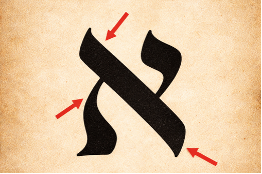
- a yud above
- a yud below
- connected by a diagonal vav
The Zohar and later Chassidic teachings see this as a bridge between heaven and earth.
- The upper yud represents the hidden or spiritual world.
- The lower yud represents the revealed world – mostly mundane and physical world.
- The vav is the channel that connects them.
Aleph therefore represents the meeting point between the Infinite and the world, and us – human beings. And now notice something remarkable. The moment in the Torah when Hashem begins speaking intimately to Moshe — the beginning of the entire system of korbanos and spiritual closeness — is marked with a small aleph. The Divine voice emerges when the human ego becomes small.
A GEMATRIA OBSERVATION
א = 1
ל = 30
ף = 80
111 is three ones — unity expressed in multiple dimensions.
Some Chassidic thinkers point out a beautiful symbolic idea: the purpose of Adam is to reveal the aleph within the world — the Oneness hidden inside the many. But the aleph must be small. When the aleph becomes large, the self (ego) becomes large. When the aleph becomes small, the Divine unity becomes visible.
A CHASSIDIC INSIGHT
The Alter Rebbe in Tanya describes Moshe as the ultimate embodiment of bittul — self (ego)-nullification before the Divine. Yet Moshe was also the greatest prophet who ever lived. The paradox is intentional. Humility in Torah thought is not thinking little of oneself. It is thinking of oneself less. Moshe did not deny his gifts. He simply understood their source. That is why the Torah introduces the Divine communication with the smallest of letters. The smaller the aleph, the clearer the call.
A PRACTICAL MESSAGE
Every person contains an aleph — a spark of Divine unity within their soul. But the noise of ego, fear, anxiety, and self-importance can make that voice difficult to hear. The Torah’s typography teaches a quiet spiritual principle: Sometimes the most powerful spiritual move a person can make is simply to make the aleph smaller. When the self becomes a little quieter, the call becomes clearer. And that call — like in the opening word of Vayikra — is always waiting. וַיִּקְרָא – Hashem is calling directly to you, and your own aleph.
Rus Devorah Wallen is an accomplished musician, performer, social worker, psychotherapist, and educator.