By Yonina Andrea Foster, Ph.D
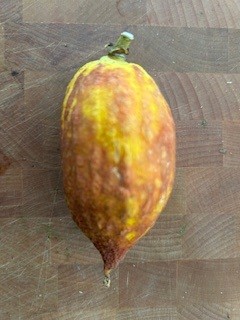 In my hand I hold the etrog, the citron from Sukkot. I scratch the surface again and inhale through my nose its fragrance, said to be from the Garden of Eden. This experience is my earthly heaven. As I enjoy this perfection, I am also sad, hesitant, wondering about the future as I see the golden fruit shrink a little more each day. I know that at some point it will become hard as a rock. I wonder how much longer I will be able to enjoy its fragrance. I attempt to hold on to Eden a little longer. Too soon there will be no fragrance from this etrog, and I will be called to go further on my journey. Lech L’cha; L’chi Lach. I am called to go forth, as I was when my mother birthed me on October 31st, many years ago. Lech L’cha was the Torah portion being studied the week I was born.
I truly came forth! “Go forth”—I am called to go in this lifetime. All of us are. I will go out to find myself, as each of us does in our own way, called by something greater, pulled to places I do not know—unexpected locales—to find… find what? Myself. From Creation to the Garden, from immortality to mortality, through generations, floods, and the choices that create a life of justice amid the black, white, and gray of decision-making.
And you? What about your journey? I wonder if our paths and stories have ever bumped into one another.
In Torah Journeys, Rabbi Shefa Gold suggests that Lech L’cha gives us a map for our spiritual journeys through seven stages. These steps reflect the events experienced by Abram (Abraham), his wife Sarai (Sarah), their relatives, and those “rachashu v’et hanefesh,” the souls they had gathered—those who left all they had known to go to a place that the Holy One had shown them. These people who left Haran can be seen, in psycho-spiritual terms, as all parts of oneself. All of them went forth from Haran to an unknown place.
They (1) left. There was (2) disappointment, then (3) development—becoming a warrior—and (4) initiation through a blessing from Melchizedek, who invoked El Elyon, the One Most High. There was (5) expansiveness—looking up to the stars in a vision of what could be, something that sustains and draws us forward—leading to (6) prophecy, another vision of the future, and finally to (7) covenant. It is in the covenant that Abram receives, as does Sarai, a letter and a piece of God’s name—and Abraham, along with his male descendants, receives the mitzvah of circumcision as a physical sign of that covenant.
In 1972, when the radio announced that Sally Priesand had become the first American woman to be ordained as a rabbi, a quiet voice within me said, “Be a rabbi.” I replied silently that I wasn’t “Jewish enough.” And so I went on my journey—all the parts of me—from Haran. Through decades of steps, it would take more than thirty years until I began rabbinic studies. During that time, I worked with a rabbi on many prayers and finally told him I felt like a “Johnny Appleseed,” a planter of Torah seeds of peace. He immediately responded, “Yonina,” explaining that it was the feminine of Yonatan (Jonathan), from the root Yona—the dove from Noah’s ark, symbol of peace. I did not ask for a new name, but “Yonina” kept whispering to me, calling me forward and soothing my heart. I felt called at a deeper level, so I asked for an aliyah, to be called up to Torah one Shabbat morning by my new name and those my parents had given me: Yonina Avigayil Rachel. A part of my heart felt called—and circumcised.
And here I am, where the stars have brought me—to serve you as a community rabbi in Buffalo, New York.
May you go forth—and may you find the place where you can become you. May the fragrance of the etrog bring you home. May the rock it becomes ground you in God’s name.
Yonina Andrea Foster, Ph.D. is a Community Rabbi and professional at Jewish Family Services.